1-Day Itinerary
One Day in Florence: The No-BS Walking Route
8 essential stops, 6km on foot, and the shortcuts nobody tells you about.
Powered by ITINE
Get this guide as a tappable itinerary
Day-by-day plan, audio tours, and one-tap Google Maps — completely free.
Destinations
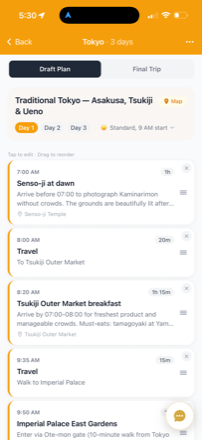
Your Itinerary
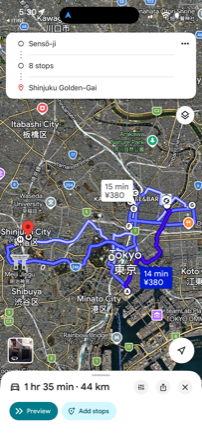
Google Maps
The Essentials Sprint
The logic of this day is simple: art in the morning when your legs and attention are fresh, altitude in the evening when the light turns gold. Start at the Accademia the minute it opens for the David — the single biggest crowd-avoidance win available in Florence. Cross to the Duomo for the dome climb while your knees still forgive you. Fuel up on ribollita at Trattoria Mario, a market lunch counter that has been feeding San Lorenzo since 1953. Give the Uffizi 90 focused minutes — six or seven rooms done properly, not a hundred done badly. Then cross the Arno into Oltrarno, where the workshops are real and the coffee costs what coffee should cost, and finish the day climbing to San Miniato al Monte, where monks singing Gregorian vespers — not selfie sticks — set the mood. Roughly 6km on foot, no bus required until your legs file a formal complaint.
Morning
8:15 AM
Galleria dell'Accademia (The David)
San MarcoPre-book your ticket for 8:15am — the gallery opens at 8:15am Tuesday through Sunday (closed Mondays, a fact that catches out a confused crowd on the sidewalk every single week) and the line triples by 9. Arrive at 8:10, and you will be standing in the Tribune with maybe 20 other people instead of 100. Do not sprint to the David. The Hall of the Prisoners — the corridor leading to him — is lined with four unfinished Michelangelo Slaves and an unfinished St. Matthew, figures half-trapped in their marble blocks, chisel marks still raw. They were meant for Pope Julius II's tomb and never completed, and walking past these half-born figures before arriving at the fully realized David gives you Michelangelo's entire creative arc in 50 meters. Then the Tribune: 5.17 meters of Carrara marble, carved by a 26-year-old from a block two other sculptors had rejected as unworkable. Notice the deliberately oversized right hand — the one that will hurl the stone — the taut tendons in the neck, the weight shifted onto one leg. This is not a victor posing; it is a man in the moment before the fight, calculating and afraid. Walk the full 360 degrees — the back view of the spine and shoulder blades is the part almost everyone misses. Spend 20 minutes here, not 5.
Book the timed-entry ticket on the official site (galleriaaccademiafirenze.it). The €4 reservation surcharge over the €21 walk-up price buys a separate, much shorter queue and saves 45–90 minutes of standing on shadeless Via Ricasoli. Do not buy from resellers charging €35+ — you are paying double for the same door.
5 min walk to the San Lorenzo market stalls — down Via Ricasoli, right on Via dei Pucci, and follow the noise toward the Medici Chapels' dome.
9:15 AM
Walk Through San Lorenzo Market
San LorenzoWalk south from the Accademia through the San Lorenzo street market stalls. Look, photograph, soak in the energy — the vendors' patter alone is worth the detour — but do not buy leather here. Most of it is Chinese-made vinyl with a 'Made in Italy' sticker slapped on at the final stage, and the 'special price for you' routine is choreographed to the syllable. If you want real Florentine leather, visit a workshop in Oltrarno this afternoon. The Basilica di San Lorenzo itself deserves a hard look from outside: Brunelleschi designed the church, but the facade was never finished — that rough brown brick you see is a 500-year-old construction site. Michelangelo drew up a marble facade for it that was never built, which is somehow very Florence. Skip the interior unless you have time to spare. If you need a caffeine top-up, the Mercato Centrale — the great 1874 iron-and-glass market hall one block in — has proper espresso at bar prices and a ground floor of produce, cheese, and lampredotto stands that shows you what Florentines actually eat.
If a vendor says 'genuine Italian leather' while standing on the street, it is not genuine Italian leather. The smell test is real, but so is the confidence of people selling vinyl.
5–7 min walk to the Duomo — take Via de' Gori onto Borgo San Lorenzo and the marble facade fills the end of the street. The dome is your compass all day.
9:45 AM
Duomo Complex + Brunelleschi's Dome Climb
DuomoYou need a pre-booked timed entry for the dome climb — get this sorted 2–4 weeks in advance at duomo.firenze.it, because these slots sell out faster than any other ticket in Florence. The 463 steps have no elevator, and the passage narrows to shoulder-width where you climb between the dome's inner and outer shells — the double-shell design was Brunelleschi's engineering masterstroke, a self-supporting structure built without scaffolding that nobody in 1420 believed possible. Claustrophobes: sit this one out and do the Baptistery instead; there is no shame in it and no turning around once you are in the stairwell. Halfway up, the route walks you along the interior balcony at the base of the dome, putting you at eye level with Vasari and Zuccari's Last Judgment frescoes — and up close they are genuinely terrifying, all demons and sinners being devoured. At the top, the panorama over Florence's terracotta rooftops is worth every gasping step; you can trace tonight's route to San Miniato on the far hill. Back at ground level, the Baptistery's 13th-century gold mosaic ceiling is the best 15 minutes on the combo ticket. Ghiberti's famous Gates of Paradise (east doors) are replicas — the originals live in the Opera del Duomo Museum — but Andrea Pisano's south doors (1336) are still the originals, standing outside in the weather like it is no big deal.
The cathedral itself is free to enter and takes 10 minutes — the interior is surprisingly austere because the good stuff was moved to the museum. The dome climb is what you are here for. Morning slots before 10am have shorter waits at the entry checkpoint, and you climb before the stairwell heats up.
6 min walk to Trattoria Mario — back along Borgo San Lorenzo past the basilica to Via Rosina. The queue outside number 2 is your landmark.
Lunch
Trattoria Mario
Order: Ribollita (Tuscan bread soup — hearty, not pretty, and exactly what 463 stairs earned you) or the bistecca if you are splitting with someone (€40-45 for a proper Fiorentina, served rare and only rare — asking for well-done is a diplomatic incident). The pasta e fagioli is also excellent. House wine is rough but honest, and at these prices you order the carafe.
Cash only. Shared tables with strangers — this is the point, not a problem. No reservations ever. Line up at 11:50 for the noon opening. They close when the food runs out, usually by 2pm. Closed Sundays and most of August.
Afternoon
1:30 PM
Ponte Vecchio
CentroWalk across the most photographed bridge in Florence — built in 1345 and the only Arno bridge the retreating Germans did not blow up in 1944. The views from it — looking up and down the Arno, not the bridge itself — are the real attraction. The jewelry shops are historic: goldsmiths have held these spots since 1593, when Grand Duke Ferdinando I evicted the butchers because he was tired of the smell drifting up into his private corridor. That corridor is the Vasari Corridor, the enclosed elevated passage running above the shops — the Medici's kilometer-long private hallway from Palazzo Vecchio to Palazzo Pitti, built so Cosimo could commute without mixing with the public. It is currently closed for renovation, expected to reopen in late 2026. As for buying gold or silver here: the markup is staggering, the tourists are captive, and literally anywhere else in the city is better. Walk the bridge, enjoy it for what it is — a medieval shopping mall with a river view — and keep your wallet in your front pocket, because this is prime pickpocket territory.
Best photos of the Ponte Vecchio itself are from Ponte Santa Trinita, one bridge west — that is where the postcard shot lives. Go there first, snap it, then walk across the real thing.
4 min walk to the Uffizi — east along Lungarno degli Archibusieri, hugging the river until the Vasari Corridor's arches hand you straight to the gallery courtyard.
2:00 PM
Uffizi Gallery
CentroPre-book. This is non-negotiable — walk-up lines run past 90 minutes in summer. The Uffizi has roughly 100 rooms across two floors of a 16th-century office building (uffizi literally means 'offices'), and trying to see everything will ruin your afternoon and your feet — Italians even have a name for the resulting art-overload collapse: sindrome di Stendhal. In 90 minutes, be ruthless. Focus on: Rooms 7–8 (early Renaissance — Piero della Francesca's Duke and Duchess of Urbino, the most recognizable profiles in art history, and Filippo Lippi's Madonna, modeled on the nun he eloped with), Rooms 10–14 (Botticelli — Birth of Venus and Primavera, breathtaking in person in a way no reproduction captures; start with Primavera, where the crowd is thinner), Room 15 (Leonardo's Annunciation, painted at 20 and already showing that impossible handling of light and air), Room 35 (Michelangelo's Tondo Doni, his only surviving finished panel painting, in colors so vivid they look wrong), and push through to Rooms 90–93 at the end for Caravaggio's Medusa — a severed head screaming from a jousting shield — and his slightly hungover Bacchus. Walk briskly past everything else without guilt; nobody ever left wishing they had spent more time with the minor Emilian Baroque painters. The building itself — the long corridor views over the Arno and Ponte Vecchio — is half the experience, so slow down at the windows.
Tuesday–Friday afternoons after 2pm are genuinely the least crowded slots. First thing in the morning is a myth — tour groups flood in at 9am, and you already spent your golden hour on the David where it matters more.
8–10 min walk to Oltrarno — out through Piazzale degli Uffizi to the river, west along the Arno, and over Ponte Santa Trinita into Via Maggio.
4:00 PM
Oltrarno Walk + Artisan Workshops
OltrarnoCross the Arno heading south and feel the volume drop. This is where Florentines actually live, eat, and drink — the neighborhood has not been turned into a museum gift shop yet, and after five hours of masterpieces your brain will thank you for streets that ask nothing of it. Walk Via Maggio past the antique dealers and peek into the woodworking, bookbinding, and leather workshops — Scuola del Cuoio (inside Santa Croce) is the famous name, but the small botteghe on Via dello Sprone and Sdrucciolo de' Pitti are where you see actual artisans bent over actual workbenches, not a show staged for tour groups. Doors are often half-open; a polite 'posso?' gets you further than you would expect. End in Piazza Santo Spirito, the neighborhood living room, presided over by the blank cream facade of Brunelleschi's last church — never finished, never decorated, and somehow perfect that way. Grab a coffee at Caffe Ricchi, sit facing the piazza, and watch the mix of students, artists, nonnas, and dogs that constitutes the best free theater in Florence. This stop is deliberately unstructured. That is the point.
If you want real leather goods, Benheart on Via della Vigna Nuova does genuine Tuscan leather at fair-ish prices. Or ask any Oltrarno workshop if they sell directly — many do, at prices that make the San Lorenzo stalls look like the joke they are.
20–25 min walk to San Miniato — east along the river to the medieval tower of Porta San Niccolò, then uphill through the free Giardino delle Rose. Steep, but the garden breaks the climb into stages.
Evening
6:00 PM
San Miniato al Monte
Oltrarno (hilltop)Everyone goes to Piazzale Michelangelo for sunset. It is a parking lot with a bronze David replica and 400 people taking the same photo. Walk 5 minutes further up the monumental stone staircase to San Miniato al Monte — an 11th-century Romanesque church whose green-and-white geometric marble facade glows amber in the late light, and which has been watching over Florence for over 1,000 years. The sunset view from the terrace is essentially identical to the piazzale's but with 90% fewer people, because the tour buses stop below. Before the light show, step inside: the 1207 inlaid marble zodiac floor, the raised presbytery over a painted crypt, and the Chapel of the Cardinal of Portugal — a jewel box of Renaissance sculpture that most visitors never find. Then take the terrace. The whole city unfolds below in gold — the dome you climbed this morning, the river you crossed twice, the tower of Palazzo Vecchio — and if you have timed it right, the Olivetan monks begin singing Gregorian vespers (5:30pm in winter, 6:30pm in summer — check the posted schedule at the door). Chant drifting out over the terrace as Florence turns amber is the single best free experience in the city, and it is not close.
The climb from Porta San Niccolò takes about 20 minutes with roughly 120m of elevation gain — the rose garden en route is free and beautiful, so use it as your breather. If your legs are done, bus 12 or 13 runs to Piazzale Michelangelo and leaves you a 5-minute walk from the church.
25 min walk back down to Piazza Santo Spirito — downhill past Piazzale Michelangelo onto Via di San Niccolò, then flat and easy along the river. All the effort was on the way up.
8:00 PM
Aperitivo in Santo Spirito
OltrarnoWalk back down to Piazza Santo Spirito for an aperitivo before dinner — by 8pm the piazza has completed its evening shift change, and the church steps are full of students, artists, and locals holding glasses of wine. Volume Firenze, a former hat-maker's workshop with the old tools still on the walls, does a solid Negroni with free snacks. The Negroni was invented in Florence in 1919, reportedly at Caffe Casoni on Via de' Tornabuoni, when Count Camillo Negroni asked the bartender to stiffen his Americano with gin instead of soda — ordering one here is not a cliché, it is a civic duty. One drink, not three: you have a date with a chicken cooked in an irresponsible amount of butter, and you want to arrive with your judgment intact.
15 min walk to Trattoria Sostanza — cross Ponte alla Carraia and head up Via del Porcellana. The doorway is easy to miss; the queue of people who called ahead is not.
Dinner
Trattoria Sostanza
Order: The burro (butter) chicken breast — a deceptively simple dish that has been on the menu since 1869. They cook it in a ridiculous amount of butter in a copper pan and it arrives golden, tender, and utterly impossible to replicate at home. The artichoke omelet (tortino di carciofi) is the other must-order. If your table wants bistecca, this is also one of the right rooms for it.
Reservations essential — call 2–3 days ahead, do not email. Cash only. Closed Saturday and Sunday. Tiny place with shared tables. If full, try Il Latini (no reservations — arrive at 7:30pm and queue for the 8pm seating, enormous portions of bistecca and ribollita, communal chaos).
Budget Breakdown
| Category | Budget | Mid-Range | Luxury |
|---|---|---|---|
| Accommodation | €60 (hostel/budget hotel) | €120–€150 (3-star hotel) | €200–€400 (boutique hotel) |
| Food & Drink | €25 (panini + trattoria) | €40–€50 (sit-down lunch + dinner) | €60–€80 (wine, aperitivo, upscale dinner) |
| Museums & Sights | €51 (Accademia €21 walk-up + Duomo combo €30) | €84 (Accademia €25 pre-booked + Duomo €30 + Uffizi €29) | €84 (same — art does not have a VIP tier) |
| Transport | €0 (walkable) | €0 (walkable) | €15 (taxi from station + bus 12) |
| Total | €125–€140 | €245–€285 | €360–€580 |
Prenota prima
Book Before You Fly
Accademia timed entry (8:15am slot)
Book the €25 timed-entry ticket on the official site (galleriaaccademiafirenze.it) and take the earliest slot. The 8:15am entries are the first to sell out because they are the only ones that get you the David without the crowd.
Brunelleschi's Dome climb
Timed reservation at duomo.firenze.it is mandatory — there is no walk-up option for the climb. These slots sell out faster than any other ticket in Florence, so book the dome before you book anything else, then build the day around it.
Uffizi timed entry
Book via the official partner site (b-ticket.com). The €4 reservation fee on top of the €25 base price is the best money you will spend in Florence — it swaps a 90-minute summer queue for a timed door.
Dinner reservation (essential if you want bistecca)
Trattoria Sostanza takes bookings by phone only — call, do not email, and have a backup date. A proper bistecca alla Fiorentina is a two-person, €40-45 commitment, so decide before you call.
High-speed train to Florence (day-trippers)
Trenitalia and Italo fares to Santa Maria Novella roughly double as departure approaches. Book the earliest arrival you can stomach — this itinerary assumes you are walking out of the station by 8am.
Se cambia il tempo
How to Adapt This Route
If it rains
Good news: two-thirds of this day is already indoors. Keep the Accademia, the Duomo complex, and the Uffizi exactly as planned — the dome climb happens entirely inside the shells, rain or not, though the stairwell gets humid. The casualty is the San Miniato sunset: in light drizzle the terrace is moody and empty and honestly still worth it, but in a proper downpour, swap it for a second museum. The Bargello — Donatello's bronze David, Verrocchio, Cellini, and almost no crowds for €9 — is the strongest wet-weather card in the city. Beware the marble street thresholds and church steps: centuries of feet have polished them into skating rinks. Move the aperitivo indoors at Volume and lengthen dinner. Florence in rain smells of wet stone and woodsmoke; it is not a ruined day, just a different one.
If it's August
Florence in August is a pizza oven with frescoes. The strategy is simple: earliest slots, siesta, evening revival. Take the 8:15am Accademia entry and a pre-10am dome slot without fail — by noon the stairwell between the dome's shells is brutal. Note that Trattoria Mario closes for most of August, so pivot lunch to the Mercato Centrale. The Uffizi at 2pm becomes your air-conditioned siesta; take the full two hours and walk slowly. Push everything after it back an hour: sunset is near 8:30pm, vespers at San Miniato run at 6:30pm, and the climb is far kinder at 7pm than at 5. Carry a bottle and refill at the public fountains. The city revives after dark — so should you.
If it's winter
Winter flips the day's geometry: sunset lands around 5pm, so the evening must come earlier. Run the morning as written — you may even get away with a €21 walk-up at the Accademia on a weekday, one of the only times of year that gamble pays. Then compress: lunch at noon sharp, Uffizi at 1:30pm for a tight 90 minutes, and be walking through Porta San Niccolò by 3:45pm to make the 5pm sunset and the 5:30pm winter vespers at San Miniato. Skip the long Oltrarno wander or fold a shortened version into the walk back down in the dark. The reward for the cold and the rearranging: museums so empty you can hear your own footsteps, and the Tribune of David nearly to yourself.
If the Accademia is sold out
Do not panic, and absolutely do not pay a reseller €35+ for the privilege of a queue. Pivot to the Bargello, which opens at 8:15am, costs €9, and is arguably the better sculpture museum anyway: Donatello's bronze David — the first free-standing male nude since antiquity — Michelangelo's tipsy Bacchus, and Ghiberti and Brunelleschi's competing Baptistery door panels, all in a 13th-century former prison you will share with a handful of people. Orsanmichele, free on Via dei Calzaiuoli, adds the great guild statues in ten minutes. Then see Michelangelo's David as a copy in Piazza della Signoria — standing exactly where the original stood from 1504 to 1873, in the political context it was carved for. That is not a consolation prize; it is a history lesson.
Pronto a partire?
Hungry?
Check our neighborhood-by-neighborhood restaurant guide with honest picks, exact dishes to order, and the tourist traps to avoid.
See Restaurant GuideFrequently Asked Questions
You can see the essential highlights — yes. You cannot see everything, and anyone who tells you otherwise is lying. The historic center is compact enough that one well-sequenced day genuinely covers the David, the Duomo dome, the Uffizi's best rooms, Oltrarno, and the finest sunset spot in the city — this route does it in about 6km of walking. What you sacrifice is depth: no Bargello, no Palazzo Pitti, no lingering. The sequencing is the whole trick — book the timed entries in advance, start at 8:15am, and refuse every detour. You will leave wanting to come back, which is the correct response to Florence.
For the Accademia and the Uffizi: absolutely, especially March through October, when walk-up lines regularly exceed 2 hours in full sun. Book the Accademia at the official site galleriaaccademiafirenze.it (€25 timed entry versus €21 walk-up — the €4 buys you a different, shorter door) and the Uffizi via its official partner b-ticket.com (€29 with the reservation fee versus €25 base). Pay the fees and move on with your life. The Duomo dome climb is stricter still: it requires a timed reservation at duomo.firenze.it and has no walk-up option at all — book it 2–4 weeks out, before anything else.
Extremely — it may be the most walkable major city in Europe. The historic center is compact: the Accademia to the Uffizi is a 15-minute walk, and nothing on this route is more than 10 minutes from the next stop until the evening climb. The only time you might want a bus is getting up to Piazzale Michelangelo or San Miniato (bus 12 or 13 — about 120m of elevation gain if you walk it, though the route through the rose garden is half the pleasure). Wear genuinely comfortable, broken-in shoes: the streets are cobblestone, the sidewalks are narrow, and this day logs around 6km plus 463 dome steps.
For one day, no. The Firenze Card costs €85 and covers 72 hours of museums — you physically cannot extract the value in a single day. Pre-booked tickets for the Accademia (€25) and Uffizi (€29) total €54, and even adding another museum would leave you short of break-even. The card makes sense for 3+ days with heavy museum appetite, where the skip-the-line access compounds. One more trap worth flagging: the Firenze Card does not cover the Duomo complex — the dome climb, Baptistery, and museum require the separate €30 combo ticket from duomo.firenze.it no matter what pass you hold.
Oltrarno (south of the Arno) gives you the best neighborhood feel, lower prices, honest restaurants at your doorstep, and walking distance to everything on this route — plus you end the evening in Santo Spirito anyway, so your bed is ten minutes from your last Negroni. The Santa Maria Novella area is the practical choice if you are arriving or leaving by train, and it puts you five minutes from dinner at Sostanza. Avoid staying right on the Duomo piazza: you pay a premium for a bell tower alarm clock, restaurant markups, and daytime crowds outside your door.
Yes. Florence is very safe by European city standards, and every walk on this itinerary — including the descent from San Miniato after sunset — is well-trafficked and fine. The main risk is pickpockets around the Duomo, the train station, Ponte Vecchio, and crowded markets during the day; it is a crime of density, not darkness, and violent crime against tourists is genuinely rare. At night, Oltrarno and Santo Spirito have a relaxed, lively atmosphere — the piazza stays busy with locals until late. Use normal city common sense: front pockets, zipped bags, and no phone dangling from a back pocket while you gawk at the dome. You will be gawking.