Travel Guide
Day Trips from Florence
Six destinations ranked honestly. Transport logistics, real costs, and which ones are actually worth leaving the city for.
Powered by ITINE
Get this guide as a tappable itinerary
Day-by-day plan, audio tours, and one-tap Google Maps — completely free.
Destinations
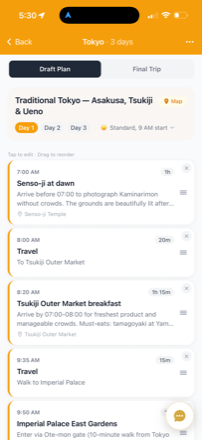
Your Itinerary
Google Maps
The destinations
Ranked Day Trips
Tested and ranked by a combination of travel ease, experience quality, and honest value for your limited time.
Siena
Siena is the anti-Florence. Where Florence is all Renaissance polish and grand museums, Siena is medieval, Gothic, and fiercely proud of being its own thing. The rivalry between these two cities goes back centuries, and honestly, a lot of travelers end up preferring Siena — it's more walkable, less crowded, and has a warmth that Florence's monumental center sometimes lacks. The undisputed centerpiece is Piazza del Campo, a sloping shell-shaped piazza that functions as the city's communal living room. People sit on the brick paving, eat gelato, and watch the light change on the Palazzo Pubblico. It's the kind of space that makes you want to cancel your return bus and stay for a week. The Duomo is equally extraordinary — the black-and-white marble striping is unlike anything in Florence, and the Piccolomini Library frescoes are some of the most vivid in Tuscany. Practically speaking: take the early bus (around 8:00-8:30 AM), arrive by 9:45, and you'll have the streets mostly to yourself for the first couple of hours. The day-trip crowds from Florence don't really hit until 11 AM. Bring comfortable shoes — Siena is built on three hills and every street is either going up or going down.
Autolinee Toscane/Flixbus from Florence bus station (next to SMN). Drops you right at Piazza Gramsci, a 5-minute walk from the center. Book Flixbus in advance for the best fares. Autolinee Toscane tickets available at the bus station tobacco shop.
Trenitalia regional service, but Siena's train station is 2 km downhill from the historic center. You'll need a city bus or a steep 25-minute uphill walk. The bus is significantly more convenient for this trip.
Best for
Architecture lovers, foodies, anyone who wants to see Italy's most beautiful piazza. Siena feels like a complete city, not a tourist attraction.
Skip if
You only have a half day — Siena deserves a full day minimum. Rushing through is pointless.
Where to eat
Antica Osteria da Divo — Pici all'aglione — thick hand-rolled pasta in a garlicky tomato sauce. Simple, perfect, and uniquely Sienese. The restaurant is built into Etruscan-era caves, which is worth the visit alone.(€€)
Suggested schedule
Morning: Arrive by 9:30-9:45 AM. Walk to Piazza del Campo first — it's magical when it's still quiet. Climb the Torre del Mangia (€10, opens at 10 AM) for panoramic views. Mid-morning: Visit the Duomo and Piccolomini Library (combined ticket €15). Lunch: Find a trattoria in the backstreets — avoid the restaurants directly on Piazza del Campo (tourist prices, mediocre food). Afternoon: Wander the contrada neighborhoods, visit the Pinacoteca or Basilica of San Domenico (free, has Saint Catherine's preserved head). Late afternoon: Final espresso on Il Campo, then bus back around 5-6 PM.
San Gimignano
San Gimignano is the medieval Manhattan of Tuscany — a tiny walled town with a cluster of stone towers that once numbered 72 (14 survive today). From a distance, the skyline is extraordinary, unlike anything else in Italy. The town itself is beautiful but tiny — you can walk the entire center in about 30 minutes, which is both its charm and its limitation. The honest truth: San Gimignano has a serious overtourism problem. The main street, Via San Giovanni, becomes a slow-moving river of tour groups by late morning. The souvenir shops are aggressive, the restaurant prices are inflated, and in peak summer it can feel more like a theme park than a living town. But — and this is a big but — if you arrive early (before 10 AM) or stay until the tour buses leave (after 4 PM), the place transforms. The golden light on the towers at sunset is legitimately one of the most beautiful things in Tuscany. The trick is timing. Come early, see the Collegiata frescoes, taste some Vernaccia, climb the Rocca for views, and then head out before the midday crush. If you have a car, combining San Gimignano with a Chianti stop on the drive back to Florence makes for a perfect full day.
Autolinee Toscane bus from Florence to Poggibonsi (50 min), then local bus 130 to San Gimignano (25 min). The connection at Poggibonsi is usually timed but check return schedules carefully — the last bus back can be surprisingly early. Buy a round-trip ticket at the Florence bus station.
Most flexible option. Parking is available outside the walls at P1 (Giubbonari) or P2 (Bagnaia). San Gimignano's historic center is entirely pedestrian. Driving also lets you combine with a Chianti stop on the way back.
Many organized tours combine San Gimignano with Siena and/or a Chianti winery. Can be good value if you want to hit multiple stops without worrying about bus connections. Quality varies wildly — read recent reviews.
Best for
Photographers, wine lovers (Vernaccia di San Gimignano is excellent), and anyone fascinated by medieval architecture. The tower skyline is genuinely stunning.
Skip if
You hate crowds — by 11 AM the main street is shoulder-to-shoulder with tour groups. San Gimignano gets more day-trippers per square meter than almost anywhere in Tuscany.
Where to eat
Gelateria Dondoli — Any seasonal flavor — Sergio Dondoli is a multiple-time world gelato champion. Try the Crema di Santa Fina (saffron) or Vernaccia sorbet. The line is always long but moves fast. Worth it.(€)
Suggested schedule
Morning: Arrive by 9:30 AM (first bus from Poggibonsi). Enter through Porta San Giovanni and walk straight to Piazza della Cisterna for photos while it's still empty. Visit the Collegiata (opens 10 AM). Mid-morning: Climb the Torre Grossa (tallest tower, €9) or walk to the Rocca for free views. Wine tasting on Via San Matteo — look for Vernaccia. Lunch: Eat early (noon) to beat the rush, or grab focaccia and eat at the Rocca. Afternoon: Browse at leisure, then catch the 3-4 PM bus back to Poggibonsi.
Chianti Wine Country
Chianti isn't a single destination — it's an entire region stretching between Florence and Siena, and it's the Tuscany you've been picturing in your head. Rolling hills striped with vineyards, lone cypress trees on ridgelines, stone farmhouses with terracotta roofs, and some of the best red wine in the world. Chianti Classico (the one with the black rooster on the label) comes exclusively from this zone, and tasting it where it's made is a fundamentally different experience from drinking it at home. The challenge with Chianti is logistics. Public transport is essentially useless for exploring wine country — buses run to Greve in Chianti but won't get you to the vineyards and estates scattered across the hills. You either need a car or a tour. If you rent a car, the freedom is unbeatable: you can drive the legendary SS222 road at your own pace, stop at any winery that catches your eye, and eat lunch in a village piazza. If you don't drive, a good small-group tour is the next best thing — just avoid the massive 50-person bus tours that rush through three wineries in four hours. A word on budget: Chianti is the most expensive day trip on this list. Between transport/tour costs, tasting fees (€15-30 per estate), and lunch, you're looking at €80-150 per person minimum. But if you love wine and food, it's money extraordinarily well spent. This is the kind of day that people talk about for years after their trip.
The most practical option if you don't have a car. Good tours include 2-3 winery visits, lunch, and stops in small villages. Book through Viator, GetYourGuide, or local operators. Small-group tours (8-15 people) are significantly better than large bus tours. Look for tours that include Greve in Chianti or Castellina.
By far the best way to explore Chianti. Rent from Florence airport or city center (from €40/day). The SS222 (Via Chiantigiana) from Florence to Siena is one of the most scenic drives in Italy — rolling hills, vineyards, cypress-lined roads. You can stop wherever you want and visit wineries on your own schedule. Book winery visits in advance — most require reservations.
Autolinee Toscane bus 365 runs to Greve in Chianti, but service is infrequent (a few times daily) and once you're in Greve, there's no practical way to visit wineries without a car. Not recommended for a wine-focused trip. Okay if you just want to see Greve town.
Best for
Wine lovers (obviously), foodies, couples, anyone who wants to see the Tuscan countryside that's on every postcard and Instagram account.
Skip if
You don't drink wine and have no interest in rural landscapes. Also skip if you're on a very tight budget — wine tastings and tours add up quickly.
Suggested schedule
If driving: Leave Florence by 9:30 AM. Take the SS222 south toward Greve in Chianti (45 min). Stop in Greve for espresso and a browse through Macelleria Falorni. Late morning: First winery visit (book for 10:30 or 11 AM). Lunch: Panzano or Castellina — eat at a local trattoria, not a winery restaurant (better value). Afternoon: Second winery visit around 2:30-3 PM. Drive through Radda in Chianti for photos. Return to Florence by 5-6 PM via the scenic route through Strada in Chianti.
Lucca
Lucca is the day trip most visitors to Florence overlook, and that's exactly what makes it so good. While everyone rushes to Pisa for a tower photo, Lucca sits just 30 minutes further up the train line with its complete Renaissance walls, car-free streets, and a pace of life that feels genuinely Italian rather than performatively touristy. The city walls are the star attraction, and they're unlike anything else in Tuscany. Fully intact, 4 kilometers around, tree-lined, and wide enough for cycling — they've been converted into a elevated park that circles the entire old town. Renting a bike and riding the loop is one of the most purely enjoyable things you can do in this part of Italy. Inside the walls, the streets are quiet enough that you can hear church bells and conversation. Piazza dell'Anfiteatro, built on the oval footprint of a Roman arena, is a lovely spot for a long lunch. Lucca is not a blockbuster destination. It doesn't have a single sight that makes you gasp. What it has is cumulative charm — the kind that sneaks up on you over a few hours of wandering, eating, and cycling. If you're starting to feel overwhelmed by the intensity of Florence, Lucca is the perfect antidote. It combines well with a quick Pisa stop on the way back if you want to see the tower without dedicating a full day to it.
Trenitalia regional train from Florence SMN. Some services are direct (80 min), others change at Pisa Centrale (add 15-20 min). Lucca's station is a 5-minute walk from the city walls. No reservation needed — just buy at the station or on the Trenitalia app. Validate your ticket before boarding if it's a paper ticket.
Take the A11 autostrada. Parking is available outside the walls — try Parcheggio Carducci (well-signed) or the free lots along Viale Cavour. The historic center inside the walls is a ZTL (restricted traffic zone), so don't drive in.
Best for
Cyclists, families, anyone who wants a relaxed pace. Lucca feels lived-in and genuine — it's a real Italian city, not a tourist attraction. Great for people who are burned out on Florence crowds.
Skip if
You want dramatic monuments or world-famous art. Lucca's charm is its atmosphere, not its individual sights. If you need Instagram-worthy landmarks, Siena is a better call.
Where to eat
Trattoria da Leo — Tordelli lucchesi — local meat-filled pasta with ragu. It's a Lucca specialty you won't find in Florence. The restaurant is packed with locals at lunch, which tells you everything. No reservations — just queue.(€€)
Suggested schedule
Morning: Take the 9:00-9:30 AM train from SMN. Arrive Lucca by 10:30-11:00. Rent a bike near Porta San Pietro and cycle the walls (30 min loop, but you'll stop for photos). Mid-morning: Lock up the bike and explore on foot — Torre Guinigi for views, then wander toward Piazza dell'Anfiteatro. Lunch: Eat in the piazza or on a side street (the restaurants directly on the piazza are acceptable here, unlike most tourist-facing squares in Italy). Afternoon: San Frediano basilica, Puccini Museum if interested, or just wander the quiet backstreets. Return train around 4:30-5:30 PM. Optional: stop in Pisa on the way back (trains run every 30 min, Pisa is 30 min from Lucca).
Pisa
Let's be honest about Pisa: it's a one-trick town, and the trick is a leaning building. The Piazza dei Miracoli with the tower, cathedral, and baptistery is genuinely beautiful — the ensemble of white marble on green grass is striking, and the tower's lean is more dramatic in person than photos suggest. But once you've taken the photo, climbed the tower (recommended, €20), and walked through the cathedral, you've essentially seen what Pisa has to offer as a day trip. The rest of Pisa is a mid-sized Italian university city that's perfectly pleasant but not especially remarkable. The walk from the station to the tower takes you through ordinary streets that feel like they belong to a different city than the manicured piazza. There's a decent food scene around Borgo Stretto if you look, and the Keith Haring mural near the station is a cool surprise, but this is not a place that rewards a full day of exploration. The smart move is to combine Pisa with Lucca. Take the morning train to Lucca, spend 4-5 hours there, then hop on the 30-minute train to Pisa in the afternoon for the tower and piazza. You'll be back in Florence by dinner with two towns checked off and neither one feeling rushed. If you only have time for one, choose Lucca — it's a far more rewarding experience.
Trenitalia regional train from Florence SMN to Pisa Centrale. Very frequent service, no reservation needed. From Pisa Centrale station, it's a 25-minute walk to the Leaning Tower or a quick bus ride (LAM Rossa line). Don't get off at Pisa San Rossore station unless you specifically want to — it's closer to the tower but served by fewer trains.
Flixbus runs direct services but the train is so frequent and convenient that there's no reason to take the bus unless the train schedule doesn't work for you.
Best for
Completionists who'd regret not seeing the tower, families with kids (the leaning angle genuinely delights children), and anyone who wants to combine it with Lucca for a full day out.
Skip if
You have limited time in Tuscany. Spending a full day in Pisa when you could be in Siena or Chianti is, frankly, a poor trade. The Leaning Tower is impressive for about 20 minutes.
Suggested schedule
Arrival: Walk or bus from Pisa Centrale to Piazza dei Miracoli (25 min walk). Tower: Climb the Leaning Tower if you've pre-booked (30-minute timed slots, €20). Cathedral: Free entry, worth 15-20 minutes inside. Baptistery: €7, worth it for the acoustics demonstration. Optional: Walk back via Borgo Stretto for a coffee, detour to see the Keith Haring mural near the station. Total time needed: 2-3 hours. If combining with Lucca: train Lucca to Pisa is 30 min, €3-4.
Fiesole
Fiesole is the easiest day trip from Florence because it's barely a day trip at all — just a 25-minute bus ride up a hill. But that short ride takes you from the dense Renaissance streets of Florence to a quiet hilltop town that was already ancient when Florence was a muddy Roman outpost. The Etruscans founded Fiesole around the 7th century BC, and the Roman amphitheater, Etruscan walls, and temple foundations are still here, set in a peaceful olive-grove archaeological zone. The main draw for most visitors is simpler: the view. From several points in Fiesole — the piazza, the restaurant terraces, the archaeological zone — you get a sweeping panorama of Florence spread out below in the Arno valley. In late afternoon, when the light turns golden and the Duomo glows, it's one of the best views in all of Tuscany. Bring a bottle of wine and find a quiet bench. Fiesole works perfectly as a half-day trip for the afternoon when you're feeling museum-fatigued and want fresh air and a slower pace. Take the bus up after lunch, explore the ruins, sit in the piazza with a coffee, watch the light change on the Florence skyline, and then bus back down for dinner. It costs almost nothing, requires zero planning, and is the kind of gentle, understated experience that often becomes a favorite memory.
Autolinee Toscane Bus #7 from Piazza San Marco in Florence. Same ticket as regular Florence city buses — buy at a tabacchi or use the Autolinee Toscane app. The bus winds up through increasingly fancy residential streets before arriving at Fiesole's main piazza. Sit on the right side for the best views on the way up.
Drive up Via San Domenico. Limited free parking in Fiesole center — arrive early if driving. The road is narrow and winding in places. Honestly, the bus is easier and gives you the same views without parking stress.
Best for
Anyone who wants panoramic Florence views, a peaceful afternoon escape, and a taste of the Etruscan civilization that predated Rome. Perfect for a half day when you're museum-fatigued.
Skip if
You're already planning Siena and Chianti — Fiesole is lovely but lightweight compared to those trips. Also skip if you have mobility issues; there are steep hills and uneven paths at the archaeological site.
Where to eat
La Reggia degli Etruschi — Pappardelle al cinghiale — wide ribbon pasta with wild boar ragu. Eaten on the terrace overlooking all of Florence. The food is very good, the view is extraordinary, and the prices reflect both. Reserve a terrace table.(€€€)
Suggested schedule
Afternoon trip: Take Bus #7 from Piazza San Marco around 1:30-2:00 PM (after a Florence morning). Arrive in Fiesole's main piazza by 2:30. Coffee in the piazza — orient yourself with the view. Archaeological zone: Roman amphitheater, Etruscan ruins, and small museum (1-1.5 hours, €12). Walk to the viewpoint terrace near the Duomo for photos. Optional: Walk down to San Domenico (20 min downhill) to see Fra Angelico's work, then catch Bus #7 back from there. Back in Florence by 5:30-6:00 PM.
Before you go
Practical Tips
The logistics that save you time, money, and frustration.
Buy train tickets on the Trenitalia app — it's reliable, shows real-time delays, and stores your tickets digitally so you don't need to validate paper tickets. Download it before your trip.
If using paper regional train tickets, you MUST validate them at the green/white machines on the platform before boarding. Unvalidated tickets can result in a €50 fine from the conductor, and they don't care that you're a tourist.
For bus trips (Siena, San Gimignano), the Florence bus station (Autostazione) is directly behind Santa Maria Novella train station. It's a slightly chaotic space — arrive 15 minutes early to find your bus bay.
Start day trips early. Most destinations are significantly more pleasant before 10:30 AM when the organized tour groups arrive. An 8:00-9:00 AM departure from Florence is ideal.
Don't try to do two major day trips in one day (e.g., Siena + San Gimignano). You'll spend more time on buses than actually seeing things, and both places deserve your full attention. The one exception: combine Lucca and Pisa, which are only 30 minutes apart by train.
Carry cash for bus tickets at smaller stations and for tipping at family-run trattorias. Many regional buses and smaller towns are still more cash-friendly than Florence itself.
Check return bus and train schedules before you leave Florence. Missing the last bus from San Gimignano or Siena means an expensive taxi back (€80-120). Take a photo of the schedule when you arrive.
If you're visiting between June and August, start even earlier and plan for a long indoor lunch break between 12:30 and 3:00 PM. Tuscan hill towns have almost no shade, and midday temperatures regularly hit 35-38°C.
Pronto a partire?
Plan Your Florence Trip
Our 5-day itinerary builds a full Tuscan day trip into the week — with exact trains, times, and costs.
See the 5-Day ItineraryFrequently Asked Questions
Siena, without question. It's a complete city with extraordinary architecture, a food culture distinct from Florence, and one of the most beautiful piazzas in Europe. If you only take one day trip, make it Siena. Chianti is the other essential if you love wine — but it requires more planning and a higher budget.
Technically yes, but we don't recommend it. The train takes 2.5-3 hours each way (with a change at La Spezia), meaning you'll spend 5-6 hours on trains for maybe 4-5 hours on the ground. You'll arrive tired and leave rushed. Cinque Terre deserves at least one overnight stay. If you're determined to go, take the earliest train possible and stick to 2-3 villages rather than trying to see all five.
For Chianti, absolutely — a car is almost essential for a proper wine country experience. For everywhere else, public transport works well enough that a car adds hassle (ZTL zones, parking, no-drinking-the-wine) without much benefit. If you're doing a multi-day Tuscany road trip that includes Chianti, Val d'Orcia, and smaller hill towns, then yes, rent a car for those days specifically.
For Chianti wine tours: at least 3-5 days in advance during peak season (April-October), and a week ahead for small-group tours with good reviews. For individual winery visits: email the estate at least a week ahead. For organized tours to San Gimignano and Siena: 2-3 days is usually fine, though popular operators sell out on weekends.
Lucca + Pisa is the classic combo — the train between them is only 30 minutes and €3-4. Spend the morning in Lucca (the better destination), then the afternoon in Pisa for the tower. San Gimignano + Chianti also works well if you have a car: visit San Gimignano in the morning, then stop at a Chianti winery on the drive back to Florence.
Fiesole is the easiest with children — short bus ride, open-air ruins to explore, gelato in the piazza. Lucca is also excellent for families — kids love cycling the walls. Pisa works because kids find the lean hilarious and the climb exciting. Siena's hills and distances can tire younger kids. Chianti wine tours are obviously adult-focused, though some family-friendly farms welcome children.