Museum Guide
The Duomo Complex: The Honest Guide
Six monuments, one pass, 463 steps — how to do the Duomo complex without wasting a slot, a euro, or your knees.
Powered by ITINE
Get this guide as a tappable itinerary
Day-by-day plan, audio tours, and one-tap Google Maps — completely free.
Destinations
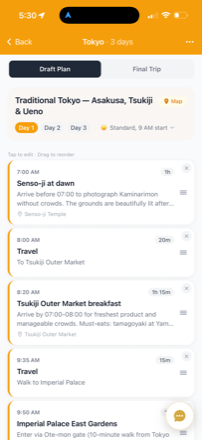
Your Itinerary
Google Maps
Hours
Cathedral Mon–Sat roughly 10:15am–4:45pm; dome climb from 8:15am. Times shift seasonally — verify your date at duomo.firenze.it
Closed
Cathedral closed to tourists on Sundays (open for worship); the dome climb runs on Sundays
Best Entry
First dome slot of the morning (8:15am), before the piazza fills
Avg Visit
2–4 hours for the full complex
Address
Piazza del Duomo
Monument by monument
Navigate the Complex
The essential works
What You Came to See
These are the works worth your time. Everything else is bonus.
The Dome (Cupola del Brunelleschi)
Filippo Brunelleschi (1420–1436)
When the cathedral was designed in the 1290s, Florence committed to a dome wider than any built since antiquity — with no idea how to actually build it. The hole in the roof sat open for decades. Brunelleschi, a goldsmith with no architectural training, won the commission with a solution nobody believed possible: two nested shells, an inner structural dome and an outer weatherproof one, rising at an angle that let the masonry support itself as it climbed. No flying buttresses. No centering — the temporary wooden framework every dome before it had required. Four million bricks laid in a self-locking herringbone pattern, plus ox-driven hoists Brunelleschi invented on the spot.
Why it matters
It is still the largest masonry dome ever constructed, and it effectively launched Renaissance architecture — proof that a living person could out-build the ancients. Every dome that followed, from St. Peter's to the U.S. Capitol, descends from this solution. Climbing between the shells means walking through the inside of the idea itself.
From the top, find the wooden model of the lantern in the Opera museum later — Brunelleschi carved solutions in wood before committing them to brick. Seeing both makes the achievement land twice as hard.
The Last Judgment frescoes
Giorgio Vasari & Federico Zuccari (1572–1579)
The inside of the dome is painted with roughly 3,600 square meters of apocalypse: concentric rings of elders, angels, saints, and — in the lowest, largest ring — a hell of spectacular cruelty, demons flaying and devouring the damned in loving detail. Vasari began it; Zuccari finished it after his death, working faster and looser (you can spot the seam if you look). From the cathedral floor 90 meters below, it reads as colorful haze. From the climb's interior balcony, it's inches from your face.
Why it matters
This is the largest fresco cycle ever painted, and the dome climb is the only way to experience it as anything other than a distant ceiling. The balcony pass turns a ticket line item into one of the most visceral encounters with painting you can have anywhere — hell at eye level, with a 90-meter drop on the other side of the parapet.
The balcony comes about halfway up the climb, before the hardest stairs. Don't rush it to “save time for the top” — the view from the summit will still be there.
Gates of Paradise (original panels)
Lorenzo Ghiberti (1425–1452)
Ten gilded bronze panels telling Old Testament stories with a depth of perspective nobody had achieved in relief sculpture before — buildings receding convincingly into space, crowds arranged in believable depth, all in a few centimeters of bronze. Ghiberti spent 27 years on them. Michelangelo reportedly said they were beautiful enough to stand at the gates of Paradise, and the name stuck. After centuries outside and a devastating dunking in the 1966 flood, the originals were restored over decades and sealed in a climate-controlled case in the museum.
Why it matters
The doors on the Baptistery itself are replicas — what you're photographing in the piazza is a copy. The originals, freshly gilded and inches from your nose behind glass, are a completely different experience: you can see the individual figures, the buildings, the sculptor's fingerprints of genius. Skipping the museum means never actually seeing one of the founding works of the Renaissance.
Stand close and pick one panel — the Jacob and Esau panel is the tour de force of perspective. The replicas outside make more sense once you've studied the real thing.
Bandini Pietà
Michelangelo Buonarroti (c. 1547–1555)
An elderly Michelangelo carving for his own tomb: the dead Christ slumping into the arms of Nicodemus, whose hooded face is a self-portrait of the artist himself. It is unfinished, and violently so — frustrated with a flaw in the marble (and, biographers suggest, with everything else), Michelangelo took a hammer to it and broke off Christ's left leg and arm before a servant stopped him. A student later patched some of the damage, clumsily, and the seams show.
Why it matters
This is the counterweight to the David. The David is a 26-year-old announcing perfection; the Bandini Pietà is an 80-year-old wrestling with mortality and losing his patience with stone. Seeing Michelangelo's own face looking down at the dead Christ he carved for his own grave is one of the most personal encounters with an artist that exists. The museum gives it a dramatic room of its own.
Circle it. The contrast between the polished passages and the raw, hammer-scarred ones is the whole story, and it only reads in three dimensions.
Baptistery mosaic ceiling
Various masters, possibly including Cimabue (c. 1225–1330)
Eight webs of gold-ground mosaic converge on the Baptistery's vault: choirs of angels, the stories of Genesis, Joseph, Mary, and John the Baptist, and dominating everything, an eight-meter Christ in Judgment separating the saved from the damned. The hell section is the showstopper — a horned Lucifer stuffing sinners into his mouth while snakes emerge from his ears to eat more. Venetian and Florentine mosaicists laid it over roughly a century.
Why it matters
This ceiling glittered over the baptism of every Florentine for 600 years — including Dante, whose Inferno borrows visibly from the devil above the font. It's also the city's great surviving link to the Byzantine gold-ground tradition that Giotto and the Renaissance would spend two centuries overturning. See it, then see the Uffizi's early rooms, and the whole arc of Florentine art clicks into place.
The mosaics face the altar, meaning the best view is from just inside the entrance looking up and across. Binoculars or a phone zoom genuinely help here.
Penitent Magdalene
Donatello (c. 1440–1455)
Mary Magdalene carved in white poplar wood: emaciated, wrapped in her own matted hair, hands not quite meeting in prayer, eyes hollowed by decades in the desert. In an era when sculpture meant idealized marble bodies, Donatello carved starvation, age, and spiritual exhaustion — and made it magnetic rather than grotesque. Traces of the original polychrome and gilding still cling to the hair.
Why it matters
This is arguably the most emotionally raw sculpture of the entire 15th century, made by the same artist whose bronze David is all youthful swagger. It stood in the Baptistery for centuries and survived the 1966 flood submerged in oily water. Nothing else in Florence — not the David, not the Pietà — prepares you for how modern it feels.
Look at her face from slightly below and to the left, the angle worshippers in the Baptistery would have had. The expression changes from ruined to radiant.
Uccello's clock
Paolo Uccello (1443)
Above the cathedral's main door hangs a one-handed clock face frescoed by Paolo Uccello, with four prophet heads in the corners. It runs counterclockwise and counts 24 hours in the old “hora italica” system, where the day ended at sunset — meaning it had to be recalibrated through the year. It still works, and it is one of the last clocks of its kind in existence that does.
Why it matters
It's a functioning piece of the 15th century embedded in daily life — a reminder that the Renaissance wasn't just altarpieces, it was engineers and painters rebuilding how ordinary things worked, right down to what time it was. It's also free: this and the view up into the dome are the two best reasons to join the cathedral line at all.
Walk in, turn around. Nearly everyone faces the altar and walks straight past the clock above the door they just entered.
The Campanile panorama
Giotto di Bondone (tower design) (1334–1359)
Giotto designed the bell tower and died three years into construction, with only the first level built; Pisano and Talenti finished it to a modified design. From its top terrace, 414 steps up, you get the one view the dome climb cannot offer: Brunelleschi's cupola itself, filling the sky at near eye level, with the terracotta city and the Tuscan hills arranged behind it.
Why it matters
Every iconic photograph of the dome is taken from here. If you can only manage one climb — by choice, by knee, or because dome slots sold out — this is the one that puts the reason you came to Florence in the frame. And unlike the dome, it needs no timed reservation.
Shoot from the third terrace, not the caged top level. Late afternoon light on the dome's east flank is the postcard.
Plan your visit
Timing Strategies
Different routes for different schedules.
The 90-Minute Hit
90 min
Short on time? These two are the essence of the complex. Book the earliest dome slot you can get (8:15am ideally), climb before the piazza heats up and fills up, and budget about 60–75 minutes for the queue-climb-summit-descent cycle. Then cross the piazza to the Baptistery and spend 15 minutes with your head tilted back under the gold mosaic ceiling. You'll have touched the two poles of the place — Renaissance engineering above, medieval glitter below — and be free by mid-morning. The Brunelleschi Pass is technically more than you need for this, but it's the only pass that includes the dome, so it's the one you're buying anyway; if you find a spare hour later in your trip, the pass's 3-day validity means the museum is still waiting for you.
Room order
Half Day, Full Pass
3.5–4 hours
The complete Brunelleschi Pass experience, sequenced to be kind to your legs. Dome climb first thing at your booked slot, while you're fresh — never after lunch. Baptistery second, as a 15-minute cooldown. Then the Opera museum for 60–90 minutes at gallery pace: Gates of Paradise, Bandini Pietà, Donatello's Magdalene, air conditioning. Finish with the cathedral interior if the line is reasonable, dropping down into the Santa Reparata crypt to visit Brunelleschi's tomb — the correct final stop. Skip the Campanile on this route unless your legs are feeling heroic; two towers in one morning is how holidays get ruined. With the pass valid 3 days, you can always come back for it.
Room order
The No-Climb Version
2.5–3 hours
For claustrophobes, bad knees, small children, and anyone who read “463 steps, shoulder-width passage, no turning back” and made a sensible decision. Buy the €20 Giotto Pass or the €15 Ghiberti Pass instead of paying for a climb you won't do. The ground-level complex is genuinely rich: the Baptistery ceiling, the full Opera museum (where the cathedral's actual masterpieces live anyway), the cathedral interior, and the crypt. For your dome view, walk 10 minutes to the free rooftop terrace of the Biblioteca delle Oblate, which puts you at eye level with the cupola for the price of a €1.50 espresso — or save it for the San Miniato al Monte terrace at sunset, which many Florentines will tell you beats the view from the dome itself, because the dome is in it.
Room order
Sunset Campanile
60–75 min
The connoisseur's move. The Campanile needs no timed reservation, stays open into the early evening (hours shift seasonally — check duomo.firenze.it for your date), and faces the dome's western flank. Time your 414-step climb so you hit the top terrace 45–60 minutes before sunset: the marble facades below turn honey-colored, the dome catches the last light, and the crowds are a fraction of midday's because everyone else is at Piazzale Michelangelo elbowing for tripod space. This works as a standalone evening on any pass tier that includes the tower (Brunelleschi or Giotto Pass), and because the passes run 3 days, you can do your dome climb one morning and save the Campanile for golden hour on another day entirely. Bring a layer — the top is breezy even in summer.
Room order
Tickets
How to Book
Brunelleschi Pass
€30The full pass: dome climb, Campanile, Baptistery, Opera museum, and Santa Reparata crypt, valid for 3 days from first use. This is the only pass that includes the dome, and the dome requires you to select a timed slot at booking — the pass alone does not get you up; the slot does. Book 2–4 weeks ahead in high season. If you're climbing the dome, this is your ticket, full stop.
Book ticketsGiotto Pass
€20Everything except the dome climb: Campanile, Baptistery, Opera museum, and crypt, also valid 3 days. The right choice if you're skipping the dome by choice or because slots sold out — the 414-step Campanile climb is included and delivers the city's best view of the dome. Do not buy this thinking you can add the dome later; upgrade paths are not guaranteed and dome slots sell out independently.
Book ticketsGhiberti Pass
€15The ground-level pass: Baptistery, Opera museum, and crypt, valid 3 days. No climbs at all. Honest value if towers aren't happening — the Baptistery ceiling and the Opera museum are two of the best sights in Florence and this is the cheapest legitimate way into both. Good for travelers with limited mobility, though check accessibility details for the crypt stairs on the official site.
Book ticketsCathedral entry
FreeThe cathedral itself costs nothing and needs no pass — just patience. The line often looks apocalyptic but moves fast; under 20 minutes is common outside peak hours. Closed to tourists on Sundays. Dress code enforced at the door: covered shoulders and knees, no exceptions, and the same applies to every monument in the complex. Note the free entry does not include the crypt, which requires a pass.
Book ticketsAttenzione
Common Mistakes
Things tourists do wrong — and how to avoid them.
Buying the Brunelleschi Pass but not reserving a dome time slot. The pass and the slot are separate steps in the same checkout — the pass grants access, the slot grants entry, and people arrive daily waving a €30 pass at a climb they cannot join. If your confirmation doesn't show a specific dome date and time, you are not booked.
Showing up in shorts or with bare shoulders. The dress code is real, enforced, and applies across the complex. Every summer morning, someone at the front of the cathedral line gets turned away in front of two hundred witnesses. Knees and shoulders covered — a scarf in your bag solves it.
Joining the wrong queue. The dome line, the Campanile line, and the cathedral line are three different lines on different sides of the buildings, and they all look equally official. Twenty minutes in the Campanile queue will not get you up the dome. Check the signage — or ask the staff — before you commit your morning to standing in it.
Doing the climb right after lunch. 463 steps in a warm, narrow stairwell on a stomach full of ribollita and Chianti is a self-inflicted wound. Book morning slots — first thing at 8:15am is the sweet spot for temperature, crowds, and dignity.
Photographing the Baptistery's east doors and thinking you've seen the Gates of Paradise. Those are replicas. The originals — restored, re-gilded, and genuinely breathtaking — are in the Opera del Duomo Museum a minute's walk away, included in every pass you might be holding. Skipping the museum means leaving Florence without seeing the real thing you queued to photograph.
Pronto a partire?
Plan Your Florence Trip
Both big museums, the Duomo climb, and the Oltrarno — our 2-day itinerary slots them in the right order.
See the 2-Day ItineraryFrequently Asked Questions
For the cathedral interior itself, no — entry is free, with a line that moves faster than it looks. For everything else on the piazza — the dome climb, Baptistery, Campanile, Opera museum, and crypt — yes, via one of three passes from duomo.firenze.it: the Brunelleschi Pass (€30, everything including the dome), the Giotto Pass (€20, everything except the dome), or the Ghiberti Pass (€15, no climbs). The dome additionally requires a timed reservation. There are no single-monument tickets.
2–4 weeks ahead for spring through early autumn — dome slots sell out faster than any other ticket in Florence, including the Uffizi. In winter you can sometimes book a few days out, but don't gamble. Book the dome first and build the rest of your Florence days around the slot. If you arrive and everything's sold out, occasionally slots reopen from cancellations on the official site; failing that, the Campanile needs no reservation and its view of the dome is the best in the city.
If you can only do one and slots are available: the dome. Climbing through Brunelleschi's double shell and passing the Last Judgment frescoes at eye level is an experience no other building on Earth offers. Choose the Campanile instead if dome slots are gone, if you want the dome in your photos (it isn't in the view from the dome), or if narrow enclosed spaces are a problem — the tower's stairs are wider, with three terraces to rest on. Doing both in one day is legal but inadvisable; the passes last 3 days for a reason.
Honestly: moderately hard, and yes, parts are genuinely tight. It's 463 steps with no elevator, the passages between the two shells narrow to single file, some stretches are low-ceilinged with slanted floors, and once you're in the stairwell there's no turning around. Anyone reasonably mobile can do it at a steady pace — people of all ages summit daily — but if you have serious knee, heart, or claustrophobia issues, sit it out without shame and do the Campanile or the ground-level monuments instead. It is not a climb to talk yourself into against your instincts.
Covered shoulders and covered knees, enforced at the entrances to the cathedral and the rest of the complex — these are consecrated buildings and the staff do turn people away. No sleeveless tops, no short shorts or miniskirts, hats off inside. The fix costs nothing: carry a scarf or light overshirt in your day bag and put it on at the door. This applies to everyone, not just women, and August heat is not accepted as a defense.
Yes — the main cathedral interior is free, no pass needed. The catch is the line, which wraps along the north flank and can look horrifying, though it typically moves quickly because the interior (stripped of most of its art, which now lives in the Opera museum) doesn't hold people long. It's closed to tourists on Sundays, when it operates as a working church. The free entry covers the nave only — the crypt below requires a pass, and the dome is a separate reserved climb.
Budget 60–75 minutes door to door: a short wait at your timed slot, roughly 20–30 minutes of climbing with the pause at the fresco balcony, as long as you like at the top (most people take 15–20 minutes — you've earned it), and the descent by a separate stairway. Add the Baptistery afterward and you have a complete 90-minute Duomo experience. The one timing rule: climb in the morning, never straight after a Florentine lunch.
If you're climbing the dome, the question answers itself — it's the only pass that includes the climb, so it's €30 or nothing. And the value stacks up honestly: dome, Campanile, Baptistery, a museum that would justify €15 on its own, and the crypt, valid over 3 days so you don't have to cram it into one morning. If you're not climbing the dome, drop to the €20 Giotto Pass or €15 Ghiberti Pass and lose nothing you were going to use. Note that the Firenze Card does not cover the Duomo complex — the pass is required regardless of what else you're holding.